
If you post about life in one city for long enough, a certain kind of comment appears.
“Anyone in Vancouver want to do this together?” “I just moved here and don’t know anyone.” “Would love a group for this.”
Sometimes a stranger replies, “Me! DM me.” Usually nothing happens after that.
Those comments are some of the most useful signals a creator can get. They tell you that your followers want to meet each other, not only you.
Why the comments keep asking
People are not imagining it. In 2012 the Vancouver Foundation surveyed 3,841 people across Metro Vancouver. One-third said it was difficult to make new friends here, and one in four said they were alone more often than they would like.
When the Foundation asked again in 2017, half of respondents said they find it difficult to make friends in the city where they live.
Across Canada, Statistics Canada’s 2021 survey found that more than 1 in 10 people aged 15 and older always or often felt lonely. Among people aged 15 to 24, it was nearly 1 in 4.
Globally, the World Health Organization’s Commission on Social Connection reported in 2025 that 1 in 6 people worldwide is affected by loneliness.
None of that means your followers are lonely. Many are busy, new in town, or between friend groups. But it explains why a comment section about running shoes or weeknight pasta turns into a place where people ask to meet.
Six signs of real demand
One “anyone in Vancouver?” is nice. A pattern is what you are looking for.
- Location in the comments. People naming the same city, or neighbourhoods in it, under different posts.
- Followers replying to each other. “I’m in East Van too!” means they are already trying to connect.
- “I just moved here” messages. New arrivals have the time and the reason to meet people.
- Requests for a group. “Is there a group for this?” is the clearest version of the signal.
- Tags and shares. Friends tagged under a post about a local spot, or shared with “we should go.”
- Your own analytics. If your platform shows where your audience lives, check whether it is spread out or concentrated in one area.
Keep a simple note. Each time you see a signal, write down the platform, the date, and the neighbourhood if someone named one. After a month, you will know whether it is a handful of people or a real pattern.
How to test it in one week
You do not need a plan, a venue, or a brand to find out whether people would show up. You need one honest question.
- Ask in a story or a post. “Would you join a small group of people from this account who live near you?” A poll or a question box works. So does one line in a newsletter.
- Ask for one detail. Neighbourhood, or nearest area. It tells you whether people could actually meet.
- Collect names in one place. A short form with name, email and neighbourhood. Nothing you do not need.
- Count by area, not in total. Ten replies from one part of town are more useful than 200 from across the continent.
A quiet response is useful too. It might mean the timing is wrong, or that your followers like you but do not want to meet each other.
Better to learn that from a poll than from an empty room.
Turning a yes into a plan
Once you know there is interest, a few principles help.
Keep groups small. Four or five people can stay in one conversation long enough to find out what they have in common. Large meetups have their place, but they are harder places to make a friend.
Make it recurring. A University of Kansas study found it takes roughly 50 hours to become casual friends and about 90 hours to become friends. One coffee is a start. A group that meets every month is a real chance.
Give people a reason to talk. A run, a walk, a dish, a book. “Come hang out” works between friends. Between strangers, it is hard work.
Match people by where they live. A group that meets twenty minutes from home lasts longer than one that needs a trip across the city.
Plan the handover. You do not need to be in the room for your followers to become friends. People may even talk more freely when the person they all follow is not there.
We wrote a longer guide on how to host a community meetup, and another on why book clubs suit almost any community.
Mistakes to avoid
Promising too much. “Let’s all hang out!” in a story can turn into 150 DMs you cannot answer. Promise one small thing and deliver it.
Making it about you. If the event depends on meeting you, it ends when you get busy. If it depends on people meeting each other, it can keep going.
Sharing people’s details. Never introduce followers by posting names or handles in public. Let them opt in, and share details privately with the people they are meeting.
Skipping safety. Meet in public places. Have house rules. Give people a way to report a problem, and follow up when they do.
Charging before you deliver. If you charge, charge for something clear: a ticket, a seat, a place in a group that has formed. People are wary of paying for a promise.
When there are more people than you can host
This is a good problem, but it is still a problem. Once the replies outnumber the seats you can organise, people need a way to meet without you arranging every group.
If you would rather do it yourself, that works too. Ask one question in a story. Count the replies by neighbourhood. Then pick one small, repeatable thing and do it twice. The second time is where friendships start.
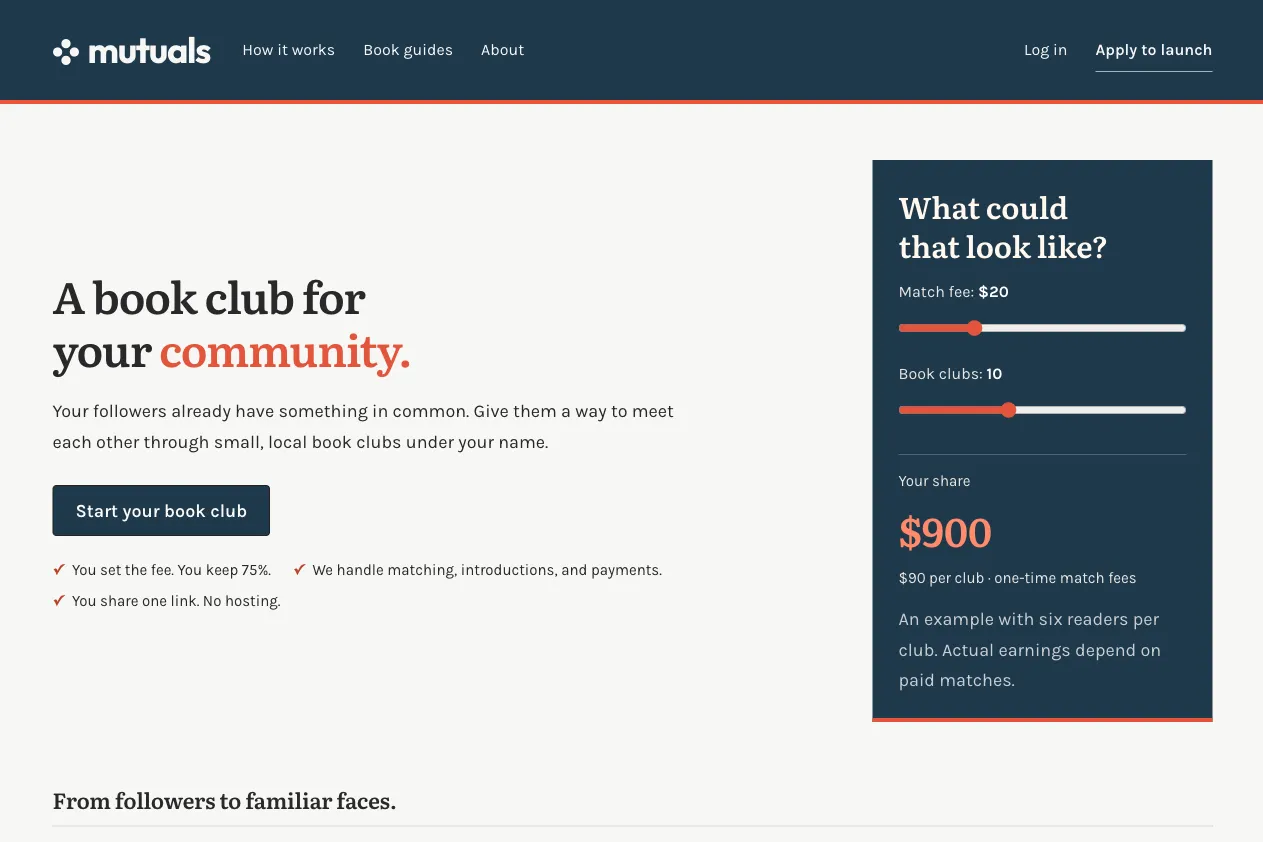
Mutuals is for communities with no book club yet, or more interest than one host can handle. Your followers sign up on your own page and tell us what they read and where they live. We match them into small book clubs nearby, send the introduction, and check in afterwards. If a group does not meet, members can be rematched. You set the match fee, keep 75%, and it is free to set up. Vancouver and nearby cities for now.
More writing
Guides for your next meeting
All guides



Written by the mutuals team.
More writing