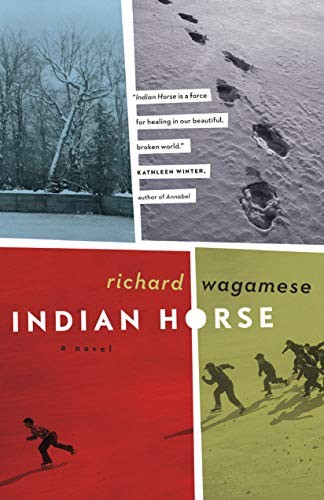
About Indian Horse
Saul Indian Horse is an Ojibway man in a treatment centre for alcoholism. He will not speak in group, so he writes his story down instead. It begins in the early 1960s, when his grandmother Naomi tries to keep him and his brother hidden on the land so they will not be taken to residential school. After his brother dies and the family scatters, Saul ends up at St. Jerome’s Indian Residential School in White River. There he finds one escape: hockey. He practises alone on the rink before dawn and turns out to have a rare gift for seeing the game before it happens. Hockey carries him to an Ojibway team in Manitouwadge and to a tryout in Toronto, and it brings him face to face with the racism of the white game. Richard Wagamese, an Ojibway writer from Wabaseemoong Independent Nations, wrote it as a hockey novel that became a book about residential schools. It was a Canada Reads finalist in 2013 and became a film in 2017. It is short, beautifully written, and hard to put down, which makes it a strong choice for a club that wants a serious book it can finish in a week.
Discussion questions for Indian Horse
Saul tells his story in writing because he cannot bring himself to speak in group. How does knowing that this is a written account, made in treatment, change the way you read his voice and what he leaves out?
Naomi hides the boys on the land and later carries Saul through the winter toward Minaki. What does she pass on to him in the short time they have? Where do you see her in the man he becomes?
When Saul’s brother dies, the family divides over how to bury him: Naomi wants the old way, the others want a Christian burial. What does that argument show you about what the schools had already done to the family before Saul ever arrived at one?
At St. Jerome’s, Saul rises before dawn to practise alone on the ice. Wagamese writes hockey almost as a spiritual practice. Even if you do not care about the sport, which passages about the game stayed with you, and why?
Father Leboutilier starts the school’s hockey team and gives Saul his chance. How did your feelings about him change as the novel went on?
Fred and Martha Kelly, who went to St. Jerome’s themselves, take Saul into their home in Manitouwadge. What do they give him that the school never could? What do they understand without saying?
With the Moose, Saul plays with joy and pride among other Indigenous players. When they start playing white town teams, they meet abuse on and off the ice. How do different players respond to it, and how does it change what the game means to Saul?
In Toronto, newspapers call Saul a savage and opponents target him. He fights back, and then he walks away. Was leaving a defeat, a choice to protect himself, or something else?
Wagamese moves quickly through Saul’s years of drinking, drifting, and work in logging camps, compared with how slowly he tells the childhood chapters. Why do you think he paced the book this way?
When Saul returns to the ruins of St. Jerome’s, he finally faces a memory he has buried for years. How did that moment change your reading of the hockey chapters that came before? (Mind any members who have not finished.)
When Saul tells the Kellys what he remembers, he learns he is not alone. What does the novel say about silence: the kind that protects people, and the kind that is passed down?
By the end, Saul wants to coach rather than play, and he goes back to the ice with old friends. Did the ending feel hopeful to you? Did it feel earned?
Themes in Indian Horse
Hockey as escape and as a battleground
For Saul, the rink is the one place where the school cannot reach him. Wagamese writes the game with real love: the speed, the sound, the way Saul reads the whole ice at once. But hockey is also where Saul meets the racism of the wider country, in the stands, in the press, and in the boards. The novel asks who Canada’s game really belongs to.
What the mind hides to survive
Saul’s account is shaped by what he can and cannot remember. The novel is built around a truth he has kept from himself for most of his life. Wagamese shows memory as something that protects a person for a time and then has to be faced if he is ever going to heal.
Land, family, and inheritance
Before the school, there is Gods Lake, Naomi, and the stories of Saul’s ancestors. The book returns to the land again and again as the source of who Saul is. What the school tries to take away is not only his childhood but that inheritance, and part of his recovery is reaching back to it.
Healing through telling
Saul cannot say his story out loud, so he writes it, and the book we read is the result. Wagamese suggests that telling the truth, to yourself first and then to others, is where recovery starts. The novel ends not with a cure but with a man ready to share the game he loves with the next generation.
Suggested book club format
- Length: About 200 pages, roughly four to five hours of reading.
- Session count: One session. The book is short and builds to a turning point that is best discussed as a whole.
- Icebreaker: “What was a game, sport, or skill that gave you somewhere to go as a kid?”
- Moderator note: The novel includes the deaths of children, racist violence, alcoholism, and the sexual abuse of children at the school, which is revealed late in the book. Name these gently before the meeting. If Indigenous members are in your circle, do not ask them to speak for anyone or to explain the history. In Canada, the National Indian Residential School Crisis Line is open 24 hours a day at 1-866-925-4419. If your group wants a second meeting, the 2017 film adaptation makes a good companion.
How a real club read this
Share how your circle discussed Indian Horse: tell us about your reading circle.
More books like Indian Horse
- Five Little Indians by Michelle Good: five residential school survivors try to build lives in Vancouver’s Downtown Eastside in the decades after they are released. Five Little Indians discussion guide.
- Demon Copperhead by Barbara Kingsolver: a boy with a gift for sport, failed by the adults around him, and the addiction that follows. Demon Copperhead discussion guide.
- Educated by Tara Westover: a memoir about memory, what a family refuses to say, and the cost of telling the truth. Educated discussion guide.
- The Heart’s Invisible Furies by John Boyne: a life bent by the power of a church, and a man who finds his way back to himself. The Heart’s Invisible Furies discussion guide.
Read Indian Horse with neighbours in a mutuals circle. Learn how to run a great reading-circle discussion. Explore more discussion guides for book-club picks.
About mutuals
mutuals matches you with a handful of neighbours whose reading taste overlaps with yours into a local reading circle close to home: monthly meetups, no app fatigue. Free to join. $15 only when we find your circle. If you want to read Indian Horse with people who live nearby, that is exactly what we do.
Turn the next chapter into a plan
Find a few nearby readers who share your taste. Free to sign up; $15 when you join your matched circle.
Also on the shelf
 Five Little Indians
 Demon Copperhead
 Educated
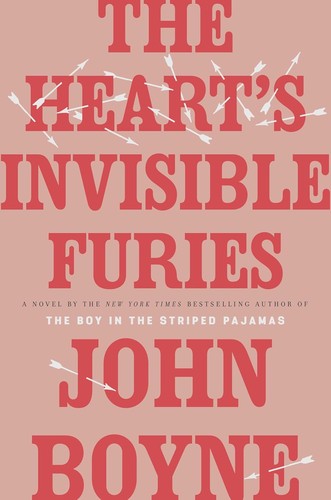 The Heart's Invisible Furies
From the reading bulletin
Original discussion questions by mutuals. Browse all book guides →